
Mastering the External Configuration Store Pattern

In today’s world of distributed systems, microservices, and cloud-native architectures, managing application configurations effectively is more critical than ever. Embedding configurations directly into the application code or relying on local configuration files can lead to inefficiencies, security risks, and operational challenges. Enter the External Configuration Store Pattern – a paradigm designed to solve these problems elegantly and at scale.
The Problem with Traditional Configuration Management
Many applications still embed configurations within code or store them in local configuration files. While simple to implement, this approach has significant drawbacks:
Static and Rigid: Updating configurations often requires redeploying the application, leading to downtime and inefficiency.
Security Risks: Hardcoding sensitive information like API keys, database credentials, or secrets makes the application vulnerable to breaches.
Scalability Bottlenecks: In distributed systems, synchronizing configurations across multiple instances becomes increasingly complex.
Environment Mismatches: Maintaining consistency across development, staging, and production environments is error-prone.
What Is the External Configuration Store Pattern?
The External Configuration Store Pattern shifts the responsibility of managing application configurations to a centralized, secure, and external system. Instead of embedding configurations within the application, they are stored in an external service that applications query at runtime or are notified of updates dynamically.
Key Components:
Centralized Configuration Store: A system like Azure App Configuration, AWS Parameter Store, HashiCorp Consul, or similar tools.
Dynamic Retrieval: Applications fetch configuration settings via APIs, SDKs, or other mechanisms.
Update Mechanisms:
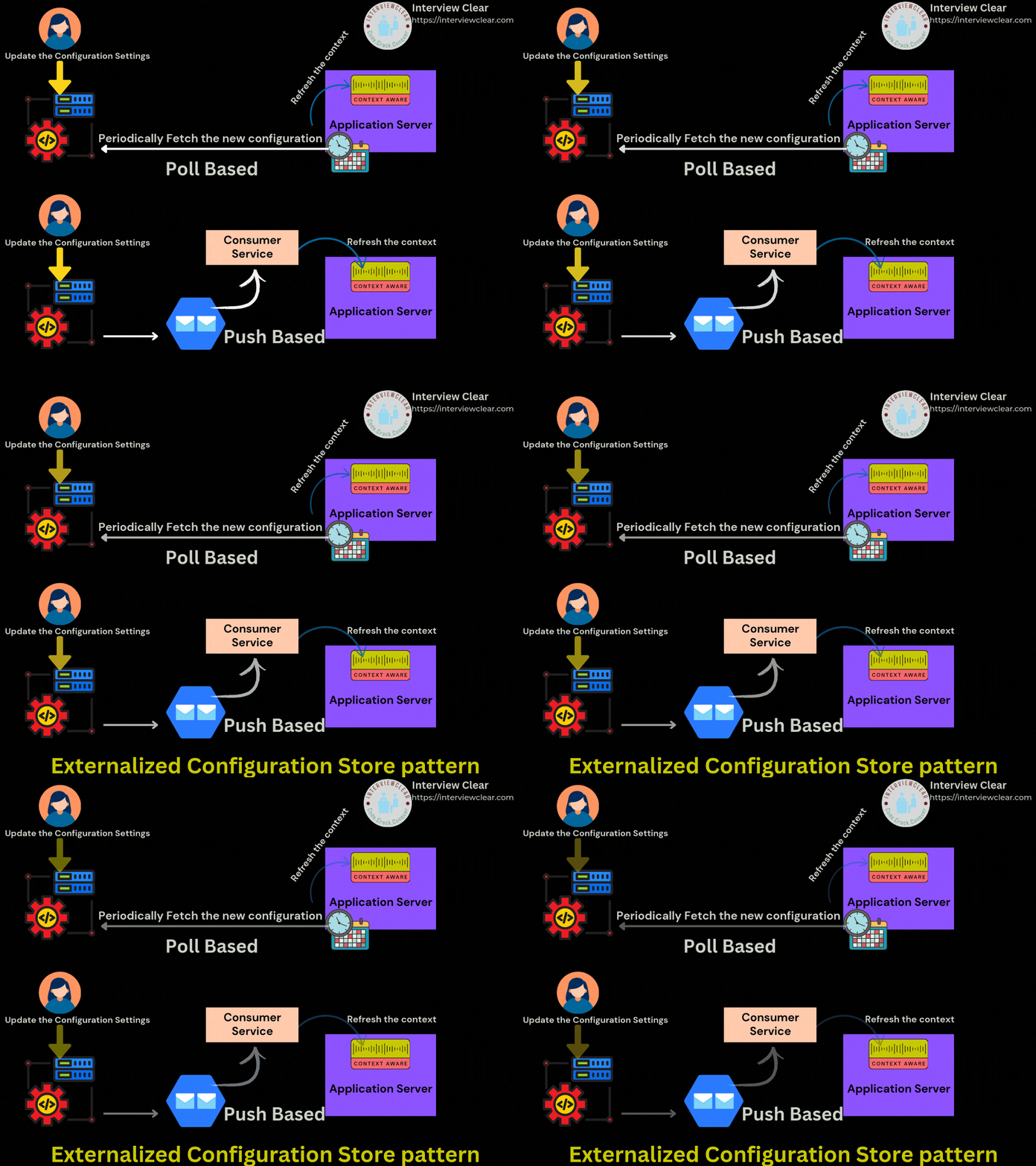
Push-Based Notifications: Notify applications of changes in real-time.
Polling: Periodically check for updates (less efficient but still valid).
Why Adopt This Pattern?
Centralized Management By storing configurations in a centralized location, you simplify the process of updating, managing, and auditing configurations across all environments.
Enhanced Security Sensitive data, such as API keys or connection strings, is stored securely in systems like Azure Key Vault or AWS Secrets Manager. Access control and encryption further safeguard these configurations.
Dynamic Updates Applications can adjust to configuration changes in real-time, without requiring a restart. This is especially useful for:
Feature toggles for A/B testing
Dynamic scaling parameters
Real-time API endpoint switches
Improved Operational Efficiency Simplify the management of configurations across development, staging, and production environments. Configuration drift and inconsistencies become a thing of the past.
How It Works
Configuration Workflow:
Setup: Add your key-value pairs or settings to an external store like Azure App Configuration.
Fetch: Applications fetch the configurations at runtime using the provided SDKs or APIs.
Dynamic Updates: Use event-driven mechanisms like Azure Event Grid to notify applications of changes dynamically. Applications fetch updated values when notified.
Dynamic Updates Without Polling
Polling for configuration updates is resource-intensive and introduces latency. Instead, you can implement push-based mechanisms to handle dynamic updates efficiently. For example:
Using Azure App Configuration with Event Grid
Event Subscription:
Azure App Configuration supports integration with Azure Event Grid.
When a configuration value changes, an event is automatically published.
Application Listener:
Your application subscribes to Event Grid notifications via a webhook, Azure Function, or Service Bus.
Upon receiving a notification, the application fetches the updated configuration dynamically.
Python Example:
from azure.data.appconfiguration import AzureAppConfigurationClient
from azure.eventgrid import EventGridConsumer
from flask import Flask, request

app = Flask(__name__)
config_store_connection = "Your_App_Configuration_Connection_String"
client = AzureAppConfigurationClient.from_connection_string(config_store_connection)

# Dynamic Configuration Cache
config_cache = {}

def update_config():
    global config_cache
    configs = client.list_configuration_settings()
    config_cache = {c.key: c.value for c in configs}

@app.route('/eventgrid', methods=['POST'])
def event_listener():
    update_config()
    return "Configuration Updated", 200

if __name__ == "__main__":
    update_config()
    app.run(port=5000)
Polling Strategy for Updates
When push-based notifications aren’t feasible, a polling mechanism can be used. The application periodically queries the configuration store to check for updates.
Python Example for Polling:
import time
from azure.data.appconfiguration import AzureAppConfigurationClient

connection_string = "Your_App_Configuration_Connection_String"
client = AzureAppConfigurationClient.from_connection_string(connection_string)

# Dynamic Configuration Cache
config_cache = {}

def update_config():
    global config_cache
    configs = client.list_configuration_settings()
    config_cache = {c.key: c.value for c in configs}

while True:
    update_config()
    print("Updated Configurations:", config_cache)
    time.sleep(60)  # Poll every 60 seconds
Java Example with Spring Boot
For Java applications, the Spring Framework provides excellent support for external configuration management. Using Spring Cloud Config and annotations like @RefreshScope, you can enable dynamic updates without restarting the application.
Spring Boot Configuration:
# application.yml
spring:
  application:
    name: demo-app
  cloud:
    config:
      uri: http://config-server-url
      fail-fast: true
management:
  endpoints:
    web:
      exposure:
        include: refresh
Dynamic Configuration with @RefreshScope:
import org.springframework.beans.factory.annotation.Value;
import org.springframework.cloud.context.config.annotation.RefreshScope;
import org.springframework.web.bind.annotation.GetMapping;
import org.springframework.web.bind.annotation.RestController;

@RefreshScope
@RestController
public class ConfigController {

    @Value("${config.property.key}")
    private String configValue;

    @GetMapping("/config")
    public String getConfigValue() {
        return configValue;
    }
}
Triggering Refresh Dynamically:
Use Spring Actuator’s
/actuator/refreshendpoint to trigger a refresh.Alternatively, integrate Spring Cloud Bus to propagate configuration changes across distributed systems.
Use Cases for the External Configuration Store Pattern
Feature Toggles: Dynamically enable or disable features in production.
Connection Strings: Change database or service endpoints without redeployment.
Rate Limiting: Dynamically adjust rate limits based on usage patterns.
Localization: Update translations and labels in real-time.
Common Tools and Services
Azure App Configuration: Centralized configuration store with integration to Azure Event Grid and Key Vault.
AWS Parameter Store: Secure configuration management with IAM-based access control.
Spring Cloud Config: Widely used in Java ecosystems with
@RefreshScopefor dynamic updates.HashiCorp Consul: Distributed key-value store with service discovery capabilities.
Etcd: Open-source distributed configuration system often used with Kubernetes.
Real-World Scenarios
Scenario 1: Scaling Microservices with Feature Toggles
Your team is deploying a new feature but wants to roll it out gradually. Using Azure App Configuration, you enable the feature for 10% of users and increase it dynamically based on metrics—all without restarting the application.
Scenario 2: Seamless Key Rotation
A database connection string needs to be updated. Using AWS Secrets Manager, you update the secret, and the change propagates to your applications immediately via Event Grid.
Takeaways
The External Configuration Store Pattern is no longer optional in the age of distributed, cloud-native systems. Its benefits, including centralized management, security, and dynamic updates, make it indispensable for building resilient and scalable applications.
Join the Conversation
How are you managing configurations in your applications? Share your experiences or challenges in the comments. Let’s discuss how modern tools and patterns can make life easier for developers and operations teams alike.